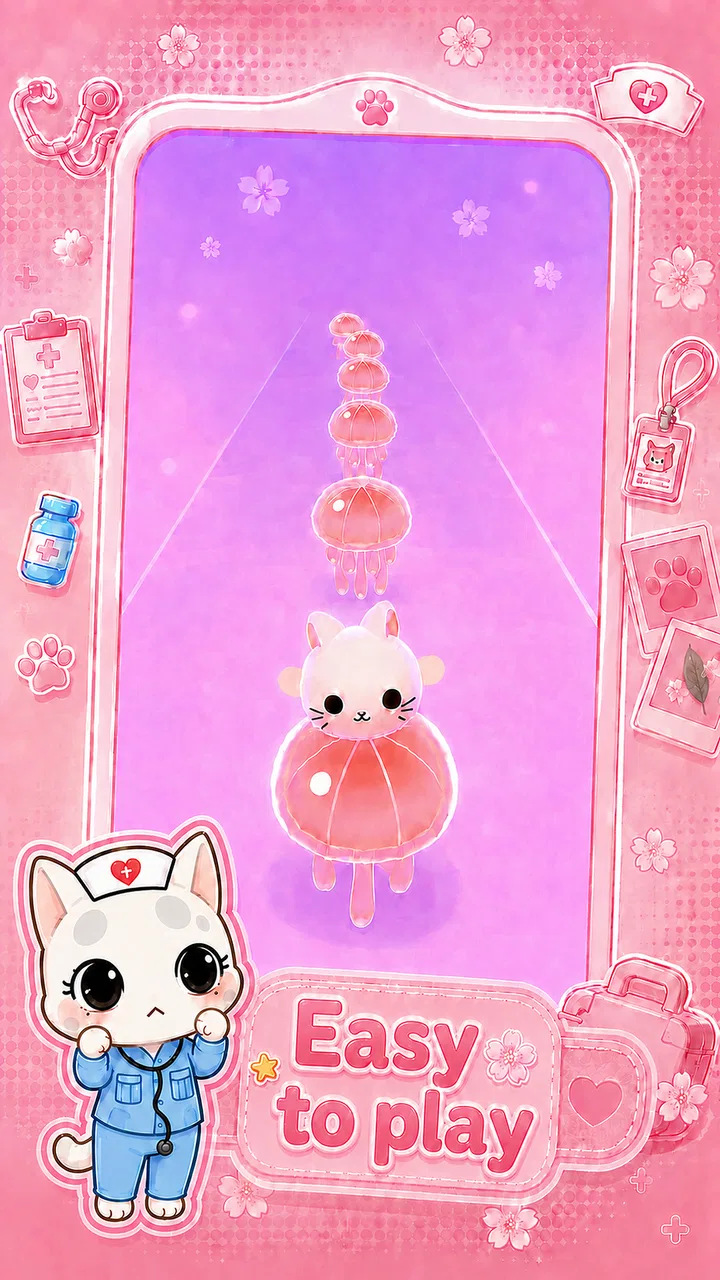
Beat Cats
- 4.7
- Rating
- 10.00M
- Installs
- Free
- Price

 Analysis by App-foxy
Beat Cats is the kind of music game that makes a strong first impression without asking me to learn a complicated control scheme. I tap along as a cat bounces across piano-style tiles, trying to keep the rhythm while the screen turns each successful move into a small burst of momentum. The idea is easy to understand, but the timing gives it enough pressure to make “just one more try” feel natural.
After spending time with it, I see the appeal clearly: this is a quick, cheerful rhythm game rather than a deep music-training tool or a large adventure. It is free to start, suitable for Everyone, and developed by SAMFEN LIMITED. Its store short description is “Beat Cats,” but that tiny phrase does not fully explain the real question I had while playing: would the game still deserve a place on my phone after the novelty of dancing cats wore off?
From instant charm to a repeatable rhythm habit
I find that Beat Cats works best when I treat each attempt as a tiny rhythm exercise, not a score I have to defend. In this section, I’ll look at how that simple starting point can turn into a repeatable habit—and where the appeal may stop carrying the experience. The useful question is not how long I can play, but what kind of return feels worthwhile.
You May Also Like

 Blood Strike: 2.5 Anniversary
Blood Strike’s Loadouts Turn Every Drop Into a Tactical Gamble
A close look at Blood Strike’s custom loadouts: how fast access to signature weapons reshapes its battle royale rhythm, rewards preparation, and narrows the gap between fights.

 Pandora - Music & Podcasts
Pandora’s Music Is Easy to Start, but Harder to Recover
Pandora’s strength is its low-effort path from a seed to a station. Its weak spot is how much confidence it asks you to place in connection, setup, and quiet recovery.

 8 Ball Pool
 Is Built on Rivalries, Rematches, and Routine
A close look at the rivalries, rematches, shared routines, and unanswered safety questions that turn a quick pool match into a persistent mobile community.

 Samsung Music
’s Quiet Strength Is Playing What You Already Own
Its reach comes less from spectacle than from dependable access to a personal library. That simplicity is both the app’s strongest retention engine and its ceiling.

 AccuWeather: Weather Radar
AccuWeather Review: A Quick, Clear Forecast for Everyday Decisions
For everyday plans, the best forecast is the one you can understand quickly. AccuWeather makes rain timing, radar, and local conditions easy to act on, with a few trade-offs.

 Hill Climb Racing
Why Hill Climb Racing Still Turns Crashes Into One More Run
A tiny car, a bumpy hill and one more upgrade: Hill Climb Racing keeps resurfacing because its simple chaos makes every near-miss feel personal.
More From Our News Desk
View All News


The first week is built around quick, satisfying attempts
The opening appeal comes from the combination of familiar piano-tile play and a playful cat theme. I do not need to study a tutorial for long before understanding the basic goal. The screen presents a moving rhythm challenge, and my job is to react at the right moment rather than plan a long sequence in advance. That makes the game comfortable to pick up during a short break, while still leaving room for mistakes when my attention slips.
What works especially well is the way the visual theme softens the pressure. Missing a tile in a serious-looking rhythm game can feel like failure; here, the bouncing cat gives the experience a lighter personality. That matters when I am playing casually. I can focus on the beat, but I do not feel as though every imperfect attempt has to become a personal test of skill.
During the first few sessions, I found the most enjoyable routine was to play in short bursts instead of treating it like a long sitting. A few attempts are enough to create a small challenge for myself: can I improve my timing, keep a cleaner run, or get farther before losing concentration? This is a better fit for the game than expecting a large story, detailed character development, or a broad collection of traditional music-game modes.
The rhythm itself also gives the game a useful physical quality. I naturally began tapping with a steadier hand instead of hurriedly pressing whenever a tile appeared. That sounds simple, but it is one of the more important lessons for new players. The game rewards calm, consistent timing more than frantic movement. If I rush because I am worried about the next tile, I usually make the next mistake easier to predict.
Why the cat theme matters, and where it stops helping
The cat presentation is not just decoration in the first few days. It gives the game a recognizable identity in a crowded field of tile-tapping titles. A plain rhythm challenge can be enjoyable, but the animated character makes the screen feel friendlier and gives the action a little more emotional feedback. For younger players and anyone who prefers cute games, that can be enough to make repeated attempts feel less mechanical.
At the same time, the theme cannot carry the entire experience forever. Once I had become familiar with the bouncing character and the basic rhythm loop, my interest depended much more on whether the moment-to-moment play continued to feel responsive. This is where Beat Cats needs to be judged as a game rather than as a visual novelty. The cats get me through the door; the timing has to convince me to stay.
That distinction is useful when deciding whether to install it for someone else. I would recommend it to a friend who enjoys approachable rhythm games, cute visual design, and short sessions. I would be more cautious with a player looking for a complex music library, detailed progression, or a game that can occupy an entire evening without repetition. Beat Cats is strongest when its limits are treated as part of its compact design rather than as missing pieces in a larger experience.
Small habits that make early play feel better
My first practical tip is to avoid playing while doing something that competes for attention. Because the controls look simple, it is tempting to treat the game as background entertainment while watching another video or chatting. That usually makes the rhythm feel harder than it really is. A quiet minute with the sound clear gives me a much better sense of the pattern and helps me decide whether a miss came from my timing or from distraction.
I also found that short sessions are more useful than immediately chasing a long run. If I keep restarting while frustrated, my taps become tense and less accurate. Taking a brief pause resets my attention. This is a small workflow, but it changes the game from a repetitive reflex test into a manageable practice loop: play, notice the timing problem, stop before irritation takes over, and return later.
Another helpful approach is to use the early attempts to learn the rhythm rather than focusing only on the result. I pay attention to whether I am consistently tapping early or late. Once I identify that tendency, I can deliberately wait a fraction longer or prepare my finger more calmly. That kind of self-correction is more valuable than simply repeating the same rushed attempt.
How it compares with familiar music-game alternatives
Compared with traditional piano-tile games, Beat Cats has a more character-driven presentation. The basic appeal remains immediate tapping and rhythm, but the cat theme gives it a softer, more playful mood. Compared with deeper rhythm games, it feels less like a long-term music collection and more like a compact reflex activity. I would choose it when I want quick access and a friendly atmosphere, not when I want extensive customization or a demanding competitive system.
That difference also affects replay value. A more elaborate rhythm game may hold me with a wide range of songs, difficulty levels, or performance goals. Beat Cats instead depends on the satisfaction of repeating its central action and improving my timing. If that loop clicks with me, the simplicity is refreshing. If I need constant new material, the game can feel narrow sooner.
What the audience numbers suggest, and what they do not guarantee
The game has passed 10 million installs and holds a 4.6 average from around 11 thousand ratings, so it has clearly found a substantial audience. Those figures make sense to me because the entry barrier is low: the controls are familiar, the tone is accessible, and the game can fit into spare moments.
Popularity does not automatically mean it will become a permanent favorite, though. A large audience can confirm that the concept is easy to enjoy, but long-term value depends on personal tolerance for repetition. I would use the strong reception as a reason to try it, not as a promise that it will replace a richer rhythm game.
Month-to-month value depends on how I use it
After the first month, the key question is no longer whether the cats are cute. It is whether I still have a reason to launch the game on an ordinary day. For me, the answer is yes when I use it as a short focus break. A few minutes of rhythm play can separate work or study tasks without demanding the commitment of a full game session.
A realistic everyday scenario would be waiting for a bus or taking a short break between errands. I can open Beat Cats, play a handful of attempts, and close it without needing to remember a story, manage a large inventory, or reach a particular checkpoint. That convenience is one of its strongest forms of recurring value. It does not compete with a long game; it fills the small spaces that a long game cannot.
There is also a mild training benefit in the way repeated play exposes my timing habits. I notice whether I react too quickly when the screen becomes busy or whether I lose concentration after a successful sequence. I would not describe the game as formal rhythm practice, but it can encourage better visual attention and steadier tapping. The benefit is modest, yet it gives repeated sessions a purpose beyond collecting another attempt.
For month-to-month use, I recommend setting a personal limit rather than playing until the game becomes irritating. The most sustainable pattern for me is to stop after a good run or after I have identified one thing to improve. That keeps the next session inviting. If I continue only because I am annoyed by a miss, the game stops feeling like a break and starts feeling like a chore.
Who is likely to keep it installed
Beat Cats is a good match for casual players who enjoy music-themed tapping, cute characters, and games that explain themselves through play. It also suits families looking for an accessible title with an Everyone content rating. Someone who wants a low-pressure way to fill a few minutes may appreciate its directness more than someone searching for a substantial campaign.
I would especially suggest it to players who like improving through repetition but do not want a complicated interface. The game’s value comes from becoming slightly more controlled and consistent over time. It can be satisfying to return after a day away and discover that a sequence which felt chaotic now seems readable.
I would tell a different friend to skip it if they need a broad musical catalogue, a strong narrative reason to return, or a game that changes dramatically from session to session. I would also steer away anyone who dislikes repeated tapping challenges. No amount of cat charm can remove the fact that the central loop remains focused on timing tiles and repeating attempts.
Free to start, with a cost decision worth considering
The game is free, which makes trying it straightforward. It also includes in-app purchases ranging from $5.99 to $39.99 per item. That does not change the basic appeal of testing the game, but it does affect how I would approach it over time. I would first decide whether the free experience already gives me enough enjoyment before considering any purchase.
My advice is to treat optional spending as a separate decision from liking the game. A purchase should solve a clear problem for me, such as supporting continued use or improving a part of the experience I already value. It should not be an automatic response to frustration after a difficult run. With a short-session game, it is particularly easy to spend in the moment and only later realize that the novelty was doing most of the work.
For parents, the Everyone rating makes the tone approachable, but I would still keep the purchase side in mind when setting up a device for a child. The important point is not that spending is required; it is that free access and optional items should be mentally separated. A child may understand the tapping immediately without understanding the value of an in-game purchase in the same way an adult does.
Maintenance is light, but attention is the real cost
Beat Cats has a low maintenance burden in the everyday sense. I do not need to organize a complicated build, remember a large set of controls, or maintain a long list of daily tasks just to enjoy a session. The current version is 0.0.25, and the game’s compact structure makes it easy to return after time away without relearning a system.
The bigger maintenance cost is keeping the experience fresh for myself. Because the core action is focused, I need to vary my reasons for playing. One session can be about relaxing, another about improving timing, and another simply about filling a wait. If every launch has the same goal of beating my previous result, fatigue arrives faster.
I also prefer to keep the game in a small rotation instead of making it my only mobile game. Used alongside a puzzle, a story game, or a more expansive rhythm title, it works as a quick reset. Asked to provide all my entertainment, it becomes easier to notice the boundaries of its design. That is not a defect so much as a realistic way to protect its best quality: immediacy.
Where fatigue begins
The first source of fatigue is repetition. The same basic interaction that makes the game accessible can also limit its ability to surprise me. Once I understand the rhythm loop, the visual presentation has less power to renew interest. Players who need frequent changes in objectives may feel that the game has shown most of its hand relatively quickly.
The second source is frustration from near-success. Rhythm games can make a tiny timing error feel disproportionately important because everything may be going well until one missed tile ends the attempt. I enjoy that tension in moderation, but it becomes tiring if I keep replaying without changing my approach. The solution is not always more persistence; sometimes it is a pause or a decision to play for fun rather than for a perfect run.
The third issue is that a cute presentation can create expectations of a larger cat-focused experience. I might initially imagine collecting, caring for, or exploring with the characters, but the main attraction remains the tile-based music challenge. Anyone installing it primarily for a virtual-pet experience may be disappointed. The cats give the game personality, but they do not turn it into a different genre.
There is also a trade-off between accessibility and depth. Because the concept is easy to grasp, I can recommend it without much explanation. But the same simplicity means experienced rhythm-game players may want more layers, more variety, or a stronger sense of progression than the game provides. In that situation, a more specialized music title would be the better long-term choice.
Practical questions I would ask before installing
If I were wondering whether it is suitable for a child, the answer starts with its Everyone content rating and its simple, playful presentation. I would still consider the child’s patience with repetition and supervise spending choices on a shared device. The game is easy to understand, but easy controls do not automatically mean every child will enjoy repeated timing challenges.
If I wanted to know whether it works for short sessions, that is where it performs best for me. I can play without committing to a lengthy story or a complicated setup. It is a particularly natural choice for brief waits, though I would not expect every session to feel equally rewarding once the initial novelty has passed.
If I were choosing between this and a more traditional piano-tile game, I would pick Beat Cats for its friendlier personality and choose the alternative if I wanted a more stripped-down focus on speed and score. If I were choosing between this and a deeper rhythm game, I would pick Beat Cats for convenience and the deeper title for variety, musical range, and a stronger long-term challenge.
If I were unsure about purchases, I would begin with the free experience and avoid spending until I had returned several times for different reasons. That test tells me more than a single exciting first session. If I still want to play after the cat theme feels familiar, then the game has earned consideration; if not, keeping it free and temporary is the sensible choice.
The long-term verdict
Beat Cats earns lasting space on my phone only when I treat it as a focused rhythm snack, not as an endlessly expanding music game. Its best qualities are immediate access, a cheerful cat identity, and a central tapping loop that can fit neatly into everyday gaps. The free entry point and Everyone rating make it easy to recommend as a low-commitment trial.
Its limits are just as clear. Repetition can catch up with the presentation, and players seeking deep progression or constant variety will probably find a better home elsewhere. The in-app purchase range also gives me a reason to stay deliberate rather than spending simply because a difficult attempt was frustrating.
My final recommendation is positive but specific: install it if you want a cute, quick music game that rewards calm timing and short, repeatable sessions. Keep it if you continue finding new small reasons to return after the first-week charm fades. The real test is not whether Beat Cats is fun once, but whether its simple rhythm loop still improves an ordinary spare minute a month later.
For me, it passes that test as a compact break-time game, though not as a replacement for a richer rhythm library. I would recommend it to a friend with that expectation clearly stated: enjoy the bounce, play with a light touch, take breaks before frustration builds, and let the game remain small. Its lasting value comes from being easy to revisit, not from pretending to be more expansive than it is.
FAQs for Beat Cats
01What is Beat Cats, and how does it work?
Beat Cats is a rhythm-based game where players tap along to the beat of various music tracks. The game features a variety of levels, each with unique songs and challenges. Players must match their taps with on-screen prompts to score points and progress through the game. The app offers both single-player and multiplayer modes, enhancing the overall experience.
02Is Beat Cats suitable for all ages?
Yes, Beat Cats is designed to be family-friendly and suitable for all ages. The game features colorful graphics and catchy tunes that appeal to both children and adults. While the game is easy to pick up for younger players, it also offers challenging levels for more experienced gamers, making it a versatile choice for everyone.
03Does Beat Cats require an internet connection to play?
Beat Cats can be played offline, making it convenient for users who want to enjoy the game without an internet connection. However, some features, such as multiplayer modes and online leaderboards, do require an internet connection to function. Players can enjoy the core gameplay offline and connect online for additional features.
04Are there in-app purchases in Beat Cats?
Yes, Beat Cats includes in-app purchases. These purchases allow players to unlock additional content, such as new songs, levels, and customization options for their characters. While the game is free to download and play, these optional purchases provide an enhanced experience for those looking to expand their gameplay.
05What devices are compatible with Beat Cats?
Beat Cats is available on both Android and iOS platforms. It supports a wide range of devices, but it's recommended to check the app store listing for specific compatibility requirements. The game is optimized to run smoothly on most modern smartphones and tablets, ensuring a seamless gaming experience across different devices.
Pros
- Engaging rhythm-based gameplay.
- Vibrant and colorful graphics.
- Wide variety of music tracks.
- Customizable cat characters.
- Regular updates with new content.
Cons
- In-app purchases can be pricey.
- Occasional ads interrupt gameplay.
- Requires constant internet connection.
- Some tracks are locked behind paywalls.
- Can be challenging for beginners.

Beat Cats
Gallery